Metal thieves are damaging British churches

Canterbury, England (ENInews)--As commodity prices soar, thieves are targeting British churches and other institutions, taking copper lightning rods, lead rain pipes, bronze statues, iron gates, even church bells and entire roofs. "Boom conditions in China, India and Brazil have created an incredible demand for lead and copper," Katri Link, senior press officer at Ecclesiastical Insurance, a private company that insures about 90 percent of churches in England and Wales) told ENInews. "Church roofs are often the target, threatening some churches with bankruptcy," she said. [520 words, ENI-11-0523]
Friday, September 30, 2011
The High Cost of Building Maintenance


Wednesday, September 28, 2011
Lutheran pastor appointed dean of Anglican cathedral in Canada
Ecumenical News International reports the following:

In a historic move, the Anglican diocese of Rupert's Land appointed a Lutheran pastor, the Rev. Paul Johnson, as dean of the diocese and incumbent for St. John's Cathedral in Winnipeg, reports the Anglican Journal. This is the first time a Canadian Lutheran pastor has been appointed dean in an Anglican cathedral in Canada. A dean is the priest in charge of a cathedral ("mother church") and occupies a senior position in a diocese. [263 words, ENI-11-0519]
Wednesday, August 17, 2011
Tuesday, August 16, 2011
More Bad News from Zimbabwe
From Ecumenical News International...
In Zimbabwe, renegade bishop's backers evict Anglican priest
Harare, Zimbabwe (ENInews)--Supporters of renegade Zimbabwean Anglican bishop Nolbert Kunonga have forced a priest and his family out of their home following a court ruling giving Kunonga control over church assets, a church spokesman said on 16 August. Kunonga recently was given control over church assets in a High Court ruling. [447 words, ENI-11-0430]
Then from the BBC...
Solomon Mujuru, who has died in a fire on his farm, was one of Zimbabwe's most powerful, wealthiest and feared politicians.
As a former army chief he was nicknamed Zimbabwe's "king-maker" - and managed to combine power with relative anonymity.
There are very few photos of him around.
"He had all the mystique of a liberation war hero that has served him to present-day politics," Patrick Smith, editor of the London-based Africa Confidential magazine, told the BBC's Focus on Africa programme.
"He didn't want to be president but he was incredibly influential in determining the jockeying for power within the hierarchy of the ruling party."
Knox Chitiyo, an analyst with the London-based think-tank Royal United Services Institute who knew Gen Mujuru personally, said he was someone "who couldn't be pushed around".
"He was very, very respected particularly among the military in Zimbabwe and among the liberation war veterans. His liberation war credentials were pretty impeccable," he told the BBC.
Gen Mujuru wife, Joice Mujuru, is one of Zimbabwe's vice-presidents - the first woman to hold such a high-ranking post in Zimbabwe.
Under his nom de guerre, Rex Nhongo, Mr Mujuru was the director of Robert Mugabe's guerrilla forces, together with the late Josiah Tongogora, during the 1970s war of independence, which ended white minority rule.
He is also said to have played a key role in Mr Mugabe's rise to the top of the Zanu party.
'Fragmentation of Zanu-PF'He was also elected MP for the north-eastern Chikomba constituency, before leaving public life in 1995 to concentrate on his business interests.
According to Mr Smith, his influence, despite not holding a political post, testifies to the strength of the military tradition in Zanu-PF politics.
Some believe his death will be a blow to the party.
John Makumbe, political analyst at the University of Zimbabwe, says Mr Mugabe "used to rely on him on what to do and what not to do".
"The nation has lost a pillar and there is likely to be more fragmentation in Zanu-PF," he told the AFP new agency.
The Mujurus are from the same Zezuru branch of Zimbabwe's majority Shona group as Mr Mugabe.
But despite his long and close ties to Mr Mugabe, there were reports two years ago that he may have fallen from grace after apparently meeting top US and UK diplomats in Harare.
Mr Mugabe has always portrayed himself as still fighting the colonial struggle - against the West.
But Gen Mujuru's death now brings into question who will succeed the 87-year-old president within the party.
Defence Minister Emmerson Mnangagwa is seen as a possible Zanu-PF successor - and there has always been fierce rivalry between him and the Mujurus.
"The demise of Mujuru would appear to give some advantage to the Mnangagwa faction," Mr Smith said.
"Until now she [Joice Mujuru] has been a beneficiary of her husband's influence in the party, army and security services. Now she'll have to put herself forward much more strongly," he said.
The Mujurus met during the war of independence and married in 1977.
She adopted the name Teurai Ropa (Spill Blood), during the struggle and claims to have shot down a Rhodesian helicopter with the machine-gun of a dying comrade and was later promoted to commander.
The Mujurus are accused of taking over at least one of the farms seized from their white owners in recent years.
Guy Watson-Smith owned 3,500-acre Alamein farm, about 80km (50 miles) south of the capital, Harare, where Gen Mujuru died in the early hours of Tuesday 16 August.
Mr Watson-Smith said the infrastructure alone was worth some $2.5m (£1.5m).
Wednesday, August 10, 2011

It's that day in the church year, when we recognize Saint Lawrence. A friend sent me the following very bad joke.
What did Jesus say to Saint Lawrence, who was grilled to death, when he got to heaven?
"Well done, good and faithful servant."
In response to such bad taste, I did a (very) little snooping, and found a nifty website connected with the cookbook, A Continual Feast. Here's it's stuff on Saint Lawrence. Enjoy!
********************************
A Continual Feast describes the martyrdom of St. Lawrence, a Roman deacon during the third century Christian persecution.Ordered by the Roman prefect to surrender the treasures of the church, he assembled the poor and took them to the prefect, saying, “Here is the church’s treasure.” According to legend he was put to death by being roasted on a grill. He is said to have remarked to his torturers: “One side is done now; you can turn me over.”
Basic Barbecue Sauce
1 cup ketchup
¼ cup yellow mustard (for tang)
1/8 cup brown sugar
1/8 cup A1 Steak Sauce
* You can modify the amount of any ingredient to fit your taste preference. If you like it bolder, add some more A1. If you like it sweeter, add more sugar. We have even substituted 2 Tablespoons of honey for the brown sugar.
* This sauce tastes great on pork, chicken, and beef. Marinate the raw meat prior to grilling and then baste with the sauce throughout the cooking process. These instant marinaters are great.

Tuesday, August 02, 2011
The Changing Face of German Catholicism
I read somewhere that something like .5% of the German populace attend church on any given Sunday. The following statistics, from Ecumenical News International (www.eni.ch) would suggest the accuracy of such a claim.
************
More Catholic departures than baptisms for first time in Germany
Berlin (ENI). For the first time since membership records have been kept, more Germans departed the Roman Catholic Church than were baptized into it in 2010, according to new data from Germany's Catholic Conference of Bishops. The new statistics, which were released with little analysis or comment, showed 170,339 baptisms for the year, and 181,193 departures from the church. However, 3,576 new members, and more than 7,400 returning Catholics, joined the church last year. [114 words, ENI-11-0405]
Wednesday, July 27, 2011
International Loehe Conference III
At present I'm listening to an excellent and provocative paper by Dr. John Stephenson of Concordia Lutheran Seminary, St Catharines, Ontario, Canada, which he is delivering at the International Loehe Conference III. This is not a very good picture, but it gives you an idea of the dynamic group that has gathered to consider the work of Wilhelm Loehe and his impact on the Lutheran tradition.

Dr. John Stephenson delivering his paper, “Löhe as an Ecumenical Lutheran,” at the International Loehe Conference III, being help on the campus of Concordia Theological Seminary, July 27, 2011.
The conference is being held at Concordia Theological Seminary, Fort Wayne, and the schedule of presenters is simply excellent. We hope to see many of the papers published ultimately through the efforts of the International Loehe Society.
Here is the schedule:
International Löhe Theological Conference III
Concordia Theological Seminary
Fort Wayne, Indiana USA
26-30 July 2011
Tuesday, July 26
2:00 p.m. Registration opens in the lobby of Sihler Auditorium
3:00 p.m. Campus Tour with Prof. Robert Roethemeyer (meet in the lobby of Sihler)
5:00 p.m. Dinner is available in the Katherine Luther Dining Hall*
6:30 p.m. Opening of Conference and Greetings
All sessions will be held in Luther Hall.
7:00 p.m. Paper I: “Löhe, Wyneken, and the Fort Wayne Seminary” –
Dr. Lawrence Rast (Concordia Theological Seminary, Fort Wayne, Indiana)
8:00 p.m. Evening Prayer
8:45 p.m. Seminary Reception on the Plaza
Wednesday, July 27
7:30 a. m. Continental Breakfast available in the Katherine Luther Dinning Hall
8:30 a.m. Paper II: “Löhe’s Correspondence with Wedemann 1849-1850 on Theory and Practice in Church and Ministry”- Dr. Wolfhart Schlichting (Editor, Confessio Augustana, Augsburg, Germany)
9:30 a.m. Morning Prayer/Coffee
10:30 a.m. Paper III: “Löhe as an Ecumenical Lutheran”- Dr. John Stephenson (Concordia Lutheran Theological Seminary, Saint Catherine’s, Ontario)
11:30 a.m. Paper IV: “Löhe’s Missiological Perspective”- Dr. Klaus Detlev Schulz (Concordia Theological Seminary, Fort Wayne, Indiana)
12:30 p.m. Lunch available in the Katherine Luther Dinning Hall
Concordia Publishing House will host a book signing for authors Geiger, Naumann, and Schulz in the Commons from 1:00 to 2:00 pm.
2:00 p.m. Paper V: “Löhe and the Ministerium of Pennsylvania: Löhe’s Reception Among his Contemporaries in the Eastern United States” –Rev. Martin Lohrmann (Doctoral candidate, Lutheran Theological Seminary at Philadelphia and Pastor of Christ Ascension Lutheran Church, Philadelphia, Pennsylvania)
3:00 p.m. Paper VI: “Confession as Mission-Retrieving Wilhelm Löhe ”
Dr. Paul Chung (Luther Seminary, Saint Paul, Minnesota)
4:00 p.m. Paper VII: “Löhe as Religious Educator”- Dr. Thomas Kothmann (University of Regensburg, Germany)
5:00 p.m. Dinner available in the Katherine Luther Dinning Hall
6:30 p.m. We will carpool to St. Paul’s Lutheran Church (1126 South Barr Street, Fort Wayne). Please meet at the flag pole in front of the Welcome Center.
7:00 p.m. Evening Prayer at St. Paul Lutheran Church with a tour of the church and refreshments after the Service.
Thursday, July 28
7:30 a.m. Continental Breakfast available at Katherine Luther Dinning Hall
8:30 a.m. Paper VIII: “Wilhelm Löhe in Deindoerfer’s History of the Iowa Synod ”- Dr. Craig Nessan (Wartburg Theological Seminary, Dubuque, Iowa)
9:30 a.m. Morning Prayer/Coffee
10:30 a.m. Paper X: “Löhe and Chiliasm in the Context of 19th Century Eschatology “ Mr. Jacob Corzine (Doctoral candidate, Humboldt University, Berlin, Germany)
11:30 a.m. International Löhe Society Meeting
12:30 p.m. Lunch available at the Katherine Luther Dinning Hall
2:00 p.m. Paper XI: “Lutheran Deaconesses in North America: Assessing Löhe’s Influence” - Deaconess Cheryl Naumann (President, Concordia Deaconess Conference and Deaconess, Redeemer Lutheran Church and School, Oakmont, Pennsylvania)
3:00 p.m. Paper XII: “ Löhe’s 1844 Agenda”- Dr. Thomas Schattauer (Wartburg Theological Seminary, Dubuque, Iowa)
4:00 p.m. Paper XIII: “Löhe and Enlightenment Movements” – Dr. Dietrich Blaufuß (Co-President, International Löhe Society, Erlangen, Germany)
5:15 p.m. We will carpool to Trinity English Lutheran Church (405 West Wayne Street, Fort Wayne). Please meet at the flag pole in front of the Welcome Center.
7:00 p.m. Evening Prayer at Trinity English Lutheran Church
Friday, July 29
7:30 a.m. Continental Breakfast available at Katherine Luther Dinning Hall.
8:30 a.m. Depart for Frankenmuth. The carpool will depart from the flag pole in front of the Welcome Center.
12:00 noon Lunch in Frankenmuth; tour the town and visit the museum.
5:30 p.m. Outdoor Dinner hosted by St. Lorenz Lutheran Church
7:00 p.m. Hymnfest at St. Lorenz with Dr. Scott Hyslop and Pastor Stephen Starke
Saturday, July 30
8:00 a.m. Depart the Bavarian Inn for Frankentrost
8:30 a.m. Immanuel Lutheran Church, Frankentrost with presentation by Rev. Mark Loest and by Mr. Matthias Honold (Archivist, Diakonie Neuendettelsau) on archival research on the Löhe colonies.
11:30 a,m, Conclusion of Conference
Sunday, July 17, 2011
"If it ever gets done..." -- PRR K4s 1361
The Pennsylvania Railroad liked to call itself "The Standard Railroad of the World," and the standard passenger locomotive for the "Standard Railroad" was the K4s. For years retired K4s #1361 stood at the park at Horseshoe Curve, just outside Altoona, Pennsylvania.

Then, however, it was pulled off the Curve and restored to working condition in the 1980s. Here's a video of it at that time.
After mechanical problems surfaced, it was time for another overhaul. However, delays, moves, and other obstacles have kept the 1361 from completion. Indeed, there are some who doubt that it will ever be fully pieced back together.
That's why the article in the Altoona Mirror from July 3, 2011, is rather encouraging. You may read the full article at the following link: http://www.altoonamirror.com/page/content.detail/id/551535/K-4-
The short version is that there is some hope and encouragement that the project is moving forward. I love steam, and the success of the Nickel Plate 765 and Pere Marquette 1225 Berkshires (http://youtu.be/eYKU4kgqe4o), and the prospect of seeing 1361 under its own power again is exciting--and not just for me.
"I can't wait to ride in that puppy," Salone said. "But let's make sure it doesn't blow up."
Friday, July 15, 2011
Trapped in the Limbo of an Eternal Present...
Let me open with a rather obvious oberservation--As an historian, memory is rather important to me. That, in part, is why I find amnesia so fascinating.
All of us forget stuff all the time, but forgetting has a deeper side. This fact was vividly demonstrated to me in a remarkable article in the November 2007 National Geographic. In it there is an article titled, “Why We Remember, Why We Forget.” This article warns of what happens when we forget. A man who has lost his memory is described this way: “Without a memory, EP has fallen completely out of time. He has no stream of consciousness, just droplets that immediately evaporate. If you were to take the watch off his wrist—or, more cruelly, change the time—he’d be completely lost. Trapped in this limbo of an eternal present, between a past he can’t remember and a future he can’t contemplate, he lives a sedentary life…” (37).
Trapped in the limbo of an eternal present…between a past he can’t remember and a future he can’t contemplate. Now think about that for a minute. With no memory, become slaves of each and every minute—living only for the moment. What a challenging way to live!
More recently I learned of the case of Henry Molaison. Molaison underwent brain surgery at the age of 27 due to epilepsy. The surgery made it impossible for him to form new memories. The result was that he had an at least average recall of public events that occurred previous to his surgery. However, while he could recall the general impressions of things he had experienced, he had lost concrete memory of the specific events, as well as the ability to form personal memories of his experiences.
As one who works in the realm of memories, this is a devastating prospect to me; while it is simultaneously fascinating. And it is why thestory on Molaison, which aired on the BBC today, was utterly engaging to me. You may find it at the following link: http://www.bbc.co.uk/programmes/b00t6zqv
The program is 30 minutes in length, and worth the time. The following is the text that appears at that link.
"Without a few unusual people, human behaviour would have remained a mystery - ordinary people whose extraordinary circumstances provided researchers with the exceptions that proved behavioural rules. Claudia Hammond revisits the classic case studies that have advanced psychological research.
"When a 27 year old man known in the text books simply as HM underwent brain surgery for intractable epilepsy in 1953, no one could have known that the outcome would provide the key to unravelling one of the greatest mysteries of the human mind - how we form new memories.
"HM was unable to remember anything that happened after the operation, which was conducted by Dr William Scoville in Hartford, Connecticut, though his life before the surgery remained vivid. For 55 years, until he died in December 2008 at the age of 82, HM - or Henry Molaison, as he was identified on his death - was studied by nearly 100 psychologists and neuro-scientists; he provided data that enabled them to piece together the memory process. The research was first coordinated by Dr Brenda Milner of McGill University and then by Professor Suzanne Corkin at MIT. Both women got to know Henry well, but he never got to know them; for him each meeting with them was the first.
"His inability to form new memories meant that HM was unable to look after himself, but he remained cheerful, with a positive outlook on his condition. He was happy, he maintained, to provide information that could help others. And this he continues to do, even after death. His brain was dissected by Dr Jacopo Annese of the Brain Observatory at UCSD, and is the subject of an ongoing on-line collaborative study."
Tuesday, July 12, 2011
450th Anniversary of Saint Basil's Cathedral
Anyone who has been to Red Square and has seen Saint Basil's Cathedral knows that it is truly an unforgettable and impressive building.

Adding to that impressiveness is its 450th anniversary, which is today, July 12, 2011. Even Google is getting into the act with a doodle recognizing the anniversary.

Here is a brief report on the anniversary from the Associated Press.
http://www.google.com/hostednews/ap/article/ALeqM5iLaX0dk9SInReA3G6dtRafbAriYA?docId=2b4267cd2bd443ba81e7dfae1d6f2bf0
Adding to that impressiveness is its 450th anniversary, which is today, July 12, 2011. Even Google is getting into the act with a doodle recognizing the anniversary.
Here is a brief report on the anniversary from the Associated Press.
http://www.google.com/hostednews/ap/article/ALeqM5iLaX0dk9SInReA3G6dtRafbAriYA?docId=2b4267cd2bd443ba81e7dfae1d6f2bf0
Russia to celebrate anniversary of St. Basil's
MOSCOW (AP) — Russia will celebrate the 450th anniversary of St. Basil's Cathedral by opening an exhibition dedicated to the so-called "holy fool" who gave his name to the soaring structure of bright-hued onion domes that is a quintessential image of Russia.
The eccentrically devout St. Basil wore no clothes even during the harsh Russian winters and was one of the very few Muscovites who dared to lambast tyrannical Czar Ivan the Terrible.
Ivan, whose gory purges claimed tens of thousands of lives, feared St. Basil as "a seer of people's hearts and minds," according to one chronicle. He personally carried St. Basil's coffin to a grave right outside the Kremlin. The cathedral, constructed to commemorate Ivan's victory over Mongol rulers, was built on the burial site.
Deputy Culture Minister Andrey Busygin said Friday that the exhibition is opening Tuesday as part of anniversary celebrations in the cathedral after a decade-long restoration that cost 390 million rubles ($14 million). The exhibition will display relics and icons of St. Basil and other religious eccentrics, who were known as "holy fools."
The exhibition will be part of massive celebrations of St. Basil's anniversary that will also include a service to be held by Russia Orthodox Patriarch Kirill and a late-night church bell concert.
"This cathedral is a shrine and a symbol of Russia," Busygin added. "It's a miracle it survived at all."
The building was severely shelled during the 1917 Bolshevik takeover of the Kremlin and was patched up during the subsequent civil war and famine. "Those gaping wounds were stuffed with whatever was at hand," said Andrey Batalov, deputy director of the State Kremlin Museums.
Early Communist leaders — who persecuted countless clerics of all faiths and destroyed tens of thousands of religious buildings — wanted St. Basil's dynamited as it blocked the way to military parades, and only the cathedral's conversion into a museum saved it.
A century earlier, Napoleon Bonaparte also ordered St. Basil's blown up during his army's hasty retreat from Moscow in 1812, but a heavy rain put down the burning fuses.
Originally named the Holy Trinity Cathedral, over the centuries it became known as the place where St. Basil is buried.
The design of its nine onion-shaped, multicolored domes combine the traditions of Russian wooden architecture with Byzantine and Islamic influences into a unique structure.
Batalov said the restoration focused on recreating the way the building looked by the late 17th century, when the nine domes were united by a wraparound floor.
By that time, St. Basil's became a symbolic New Jerusalem and the center of Palm Sunday walks, when the Moscow Patriarch approached it sitting on a donkey to recreate Jesus' arrival in Jerusalem.
Copyright © 2011 The Associated Press. All rights reserved.
Friday, June 10, 2011
Things Are Tough All Over
Apparently the Lutheran World Federation (LWF) is feeling the pinch. This is from Ecumenical News International.
Member contributions an issue of concern at Lutheran World Federation meeting
Geneva (ENInews)--Members of the Lutheran World Federation (LWF) today expressed concern about budget problems at the LWF Council meeting in Geneva. Factors such as the global financial crisis, the weakness of the euro and the dollar against the Swiss franc, and a decline in membership fees have combined to create concern about the organization's financial situation. The reduction in contributions from members in the southern hemisphere was another topic of discussion. Some southern churches are not paying their dues, creating tension with members in the north. Member contributions have decreased about nine percent over the past two years, to three million dollars, though this is partly due to the weakness of some currencies. The fees are based on a formula indicating the relative wealth of a given church compared with those in other countries. [348 words, ENI-11-0301]
Thursday, May 05, 2011
The Constancy of Change
by Lawrence R. Rast Jr.
The original of this article appeared in the May 2011 Lutheran Witness (pp. 4-5). It may also be accessed at http://www.wmltblog.org/2011/05/constancy-of-change/
Economic collapse, rapid social change, troubling finances . . . is this the LCMS of 1911 or 2011?

President Oliver Harms presided over the 1967 Synod convention and over the Ebenezer Year.
Photo courtesy Concordia Historical Institute
Climate change, economic collapse, familial displacement, rapid social change, changing morals—so chaotic were the circumstances of life that some began to predict the imminent end of the world. These were the conditions that faced our Synod. Were. This situation, which seems so familiar to us today, was precisely the one into which C. F. W. Walther and F. C. D. Wyneken, the first two presidents of the LCMS, stepped as they established and led the Synod during uncertain and challenging times. We could just as easily say that they are the circumstances that face our Synod today, for we, too, live in a period of rapid and somewhat unsettling change.
Blessings and challenges
The Lutheran Church—Missouri Synod offers one of the great stories of American Christianity: a story of blessings and challenges. Founded in 1847 with just 12 pastors and 16 congregations, it was merely one among many small Lutheran synods (at least 58 were formed between 1840–1875). Why did Missouri survive? More pointedly, why did it thrive?
One key reason was its willingness to engage its context and apply its confession in creative ways. What the Synod attempted didn’t always work according to human standards, and at other times, it did so in incredibly difficult circumstances.
Missouri at its beginning was German, and its outreach was to immigrants. However, by 1911, the Synod welcomed the English Evangelical Lutheran Synod of Missouri, Ohio, and Other States into its structure as the non-geographical “English District.” Between 1917–1936, more than two-thirds of the Synod’s congregations moved to using English in worship.
Even as the Synod shifted its language, it began to take on some of the characteristics of an American denomination. As its institutions flourished, its assets and holdings increased, its bureaucracy began to expand and more institutions competed for limited dollars.
The result was a budget shortfall. In 1917, a group of twelve laymen addressed the Synod’s $100,000 debt and then continued their efforts, eventually forming the Lutheran Laymen’s League (LLL). Their next project was to raise $2.7 million to fund a pension plan for professional church workers.
The roaring twenties, however, were a time of limited numerical growth for the LCMS. The Synod simultaneously began to accrue a significant deficit, which, by 1928, totaled more than $750,000. But things were about to get worse.
The LCMS was hit hard by the Great Depression. Synod’s programs were trimmed, the budget experienced extreme tension and receipts declined. The people of the congregations were generous in their support, but their discretionary spending was limited. The result was real hardship. Not surprisingly, congregations struggled to support their pastors, and many graduates of the seminaries endured sustained waits for calls into the ministry.
Finally, depression gave way to war, which in turn gave way to a “baby boom” and a period of incredible numerical and institutional growth for the LCMS. The Synod doubled in size. Its bureaucracy and budget expanded even more. So fast was the expansion that the Synod began to experience stress.
In the 1960s, a new set of financial and theological pressures arose. As some became concerned over what they perceived were “changes” in theology and centralization/bureaucratization, they withheld their offerings in significant enough amounts to impact the Synod’s budget. In 1962, Synod adopted the “Faith Forward” effort, but it did not generate meaningful interest. Even as Synod tried to trim down, the pointed remarks of an active missionary told the real story: “Synod says it has no money. We in the mission fields feel like crying.”
In response, in 1965 the Synod approved a major “thank offering” to be held within the next two years. By January 1966, The Lutheran Witness reported that President Oliver Harms would soon proclaim 1967 as the “Ebenezer Year.” The goal of “Ebenezer” (“Stone of Help” or “Rock of Salvation” [1 Sam. 7:12]) was to raise at least $40 million.
But Ebenezer was by all accounts a failure. The 1969 convention heard that less than $15 million had actually been received. As a result, the Synod had to pare its mission efforts back even further. Difficult years followed as membership peaked in 1971 and declined in most years since. Still, at the end of the 1970s, “Forward in Remembrance,” the largest capital campaign by an American Protestant church up to that point in time, highlighted how God had blessed the LCMS.
Today we find ourselves again in a challenging time. Finances are tight. Membership has not increased as we had hoped as we approach the 500th anniversary of the Reformation in 2017. Things seem to be changing more quickly than ever.
In the midst of change
Blessings and challenges: That is the way of history as we move through a world toward a future that is, humanly speaking, uncertain. But we have always faced change and will continue to do so until that absolutely certain day, that final day when our Lord returns and gathers all of His people to Himself.
In the meantime, we pray to be faithful in the midst of change. And here the experiences of our Synod over time—both positive and negative—can be instructive. The early leaders of our Synod helped people through difficult periods of transition. They did so by simultaneously holding fast and firmly to biblical doctrine as faithfully confessed in the Lutheran Confessions, successfully interpreting a rapidly changing culture that was entirely new to them and then providing the visionary leadership to move the Synod forward in vigorous mission and ministry.
The story of the LCMS leads us to rejoice in God’s faithfulness, even as we have no illusions about the human challenges before us. However, as we frame our life together in terms of God’s rich and abundant grace, we can recognize that God has given us, through our predecessors, extraordinary gifts and a capacity beyond anything our parents in the faith could have dreamed. The challenges are indeed great. God’s blessings are even greater.
Lawrence R. Rast Jr.
About the Author: Dr. Lawrence R. Rast Jr. is academic dean of Concordia Theological Seminary, Fort Wayne, Ind.
May 2011
The original of this article appeared in the May 2011 Lutheran Witness (pp. 4-5). It may also be accessed at http://www.wmltblog.org/2011/05/constancy-of-change/
Economic collapse, rapid social change, troubling finances . . . is this the LCMS of 1911 or 2011?
President Oliver Harms presided over the 1967 Synod convention and over the Ebenezer Year.
Photo courtesy Concordia Historical Institute
Climate change, economic collapse, familial displacement, rapid social change, changing morals—so chaotic were the circumstances of life that some began to predict the imminent end of the world. These were the conditions that faced our Synod. Were. This situation, which seems so familiar to us today, was precisely the one into which C. F. W. Walther and F. C. D. Wyneken, the first two presidents of the LCMS, stepped as they established and led the Synod during uncertain and challenging times. We could just as easily say that they are the circumstances that face our Synod today, for we, too, live in a period of rapid and somewhat unsettling change.
Blessings and challenges
The Lutheran Church—Missouri Synod offers one of the great stories of American Christianity: a story of blessings and challenges. Founded in 1847 with just 12 pastors and 16 congregations, it was merely one among many small Lutheran synods (at least 58 were formed between 1840–1875). Why did Missouri survive? More pointedly, why did it thrive?
One key reason was its willingness to engage its context and apply its confession in creative ways. What the Synod attempted didn’t always work according to human standards, and at other times, it did so in incredibly difficult circumstances.
Missouri at its beginning was German, and its outreach was to immigrants. However, by 1911, the Synod welcomed the English Evangelical Lutheran Synod of Missouri, Ohio, and Other States into its structure as the non-geographical “English District.” Between 1917–1936, more than two-thirds of the Synod’s congregations moved to using English in worship.
Even as the Synod shifted its language, it began to take on some of the characteristics of an American denomination. As its institutions flourished, its assets and holdings increased, its bureaucracy began to expand and more institutions competed for limited dollars.
The result was a budget shortfall. In 1917, a group of twelve laymen addressed the Synod’s $100,000 debt and then continued their efforts, eventually forming the Lutheran Laymen’s League (LLL). Their next project was to raise $2.7 million to fund a pension plan for professional church workers.
The roaring twenties, however, were a time of limited numerical growth for the LCMS. The Synod simultaneously began to accrue a significant deficit, which, by 1928, totaled more than $750,000. But things were about to get worse.
The LCMS was hit hard by the Great Depression. Synod’s programs were trimmed, the budget experienced extreme tension and receipts declined. The people of the congregations were generous in their support, but their discretionary spending was limited. The result was real hardship. Not surprisingly, congregations struggled to support their pastors, and many graduates of the seminaries endured sustained waits for calls into the ministry.
Finally, depression gave way to war, which in turn gave way to a “baby boom” and a period of incredible numerical and institutional growth for the LCMS. The Synod doubled in size. Its bureaucracy and budget expanded even more. So fast was the expansion that the Synod began to experience stress.
In the 1960s, a new set of financial and theological pressures arose. As some became concerned over what they perceived were “changes” in theology and centralization/bureaucratization, they withheld their offerings in significant enough amounts to impact the Synod’s budget. In 1962, Synod adopted the “Faith Forward” effort, but it did not generate meaningful interest. Even as Synod tried to trim down, the pointed remarks of an active missionary told the real story: “Synod says it has no money. We in the mission fields feel like crying.”
In response, in 1965 the Synod approved a major “thank offering” to be held within the next two years. By January 1966, The Lutheran Witness reported that President Oliver Harms would soon proclaim 1967 as the “Ebenezer Year.” The goal of “Ebenezer” (“Stone of Help” or “Rock of Salvation” [1 Sam. 7:12]) was to raise at least $40 million.
But Ebenezer was by all accounts a failure. The 1969 convention heard that less than $15 million had actually been received. As a result, the Synod had to pare its mission efforts back even further. Difficult years followed as membership peaked in 1971 and declined in most years since. Still, at the end of the 1970s, “Forward in Remembrance,” the largest capital campaign by an American Protestant church up to that point in time, highlighted how God had blessed the LCMS.
Today we find ourselves again in a challenging time. Finances are tight. Membership has not increased as we had hoped as we approach the 500th anniversary of the Reformation in 2017. Things seem to be changing more quickly than ever.
In the midst of change
Blessings and challenges: That is the way of history as we move through a world toward a future that is, humanly speaking, uncertain. But we have always faced change and will continue to do so until that absolutely certain day, that final day when our Lord returns and gathers all of His people to Himself.
In the meantime, we pray to be faithful in the midst of change. And here the experiences of our Synod over time—both positive and negative—can be instructive. The early leaders of our Synod helped people through difficult periods of transition. They did so by simultaneously holding fast and firmly to biblical doctrine as faithfully confessed in the Lutheran Confessions, successfully interpreting a rapidly changing culture that was entirely new to them and then providing the visionary leadership to move the Synod forward in vigorous mission and ministry.
The story of the LCMS leads us to rejoice in God’s faithfulness, even as we have no illusions about the human challenges before us. However, as we frame our life together in terms of God’s rich and abundant grace, we can recognize that God has given us, through our predecessors, extraordinary gifts and a capacity beyond anything our parents in the faith could have dreamed. The challenges are indeed great. God’s blessings are even greater.
Lawrence R. Rast Jr.
About the Author: Dr. Lawrence R. Rast Jr. is academic dean of Concordia Theological Seminary, Fort Wayne, Ind.
May 2011
Wednesday, April 20, 2011
Grain Elevator
The following is a wonderful documentary on the "prairie sentinels," the grain elevators of the great plains. Released in 1981, this Canadian film captures the rhythm of the operation of these key elements of the North American economy.
Monday, February 21, 2011
Nice Footage of the Pere Marquette Railroad
After the Pennsylvania Railroad, several other railroads are of interest to me--but none more so than the Pere Marquette.
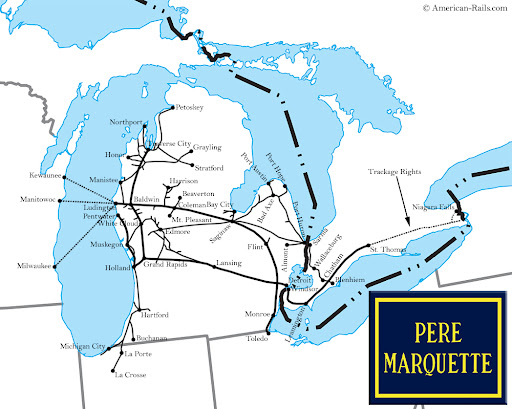
At one time part of the old Van Sweringen empire, it later merged with the Chesapeake and Ohio. C&O's streamlined passenger "Pere Marquette" service in the 1940s featured some of the most beautiful passenger equipment of the streamlined era.

But this evening a little YouTube surfing turned up the following. And while it's not the greatest footage, it still is pretty cool!
For a better introduction to the PM, follow this link: http://www.american-rails.com/pere-marquette-railway.html
Sunday, February 13, 2011
"Africa through a Lens"
The United Kingdom's National Archives is sharing an incredible collection of well over 1,000 photos from England's colonial office. You may find it at this address: http://www.nationalarchives.gov.uk/africa/
Beginning in the 1860s and stretching forward well into the 20th century, the pictures show the beauty of Africa's people and geography, as well as hinting (at the very least) at some of the tensions inherent in the colonial enterprise. Nigeria has the largest number of photos (904), with South Africa coming in second (627), and Kenya third (346). A word of caution--exploring the collection can take up a lot of your time. But it will be worth it.

Beginning in the 1860s and stretching forward well into the 20th century, the pictures show the beauty of Africa's people and geography, as well as hinting (at the very least) at some of the tensions inherent in the colonial enterprise. Nigeria has the largest number of photos (904), with South Africa coming in second (627), and Kenya third (346). A word of caution--exploring the collection can take up a lot of your time. But it will be worth it.
Tuesday, February 08, 2011
Dedication of Concordia College, Selma, Chapel
It was a great honor and privilege to be at Concordia College, Selma, today, to participate in the dedication of the new chapel in the recently acquired "west campus"area. The remarks of LCMS President Harrison about Selma's unique history and opportunities and the kind words of Selma's President Tilahun Mendedo regarding yours truly and, more importantly, Concordia Theological Seminary, Fort Wayne, were especially appreciated. Great things are happening at Selma under the leadership of Dr. Mendedo, who received his Ph.D. in Missiology from Concordia Theological Seminary, Fort Wayne. It was truly a great day!
Friday, January 21, 2011
The Confessions of Saint Peter -- A Chapel Sermon on Mark 8:27-35
An audio link to the chapel service may be found here: http://www.ctsfw.edu/Page.aspx?pid=457
Mark 8:27-35 Lawrence R. Rast, Jr.
Mark 8:27-35 Lawrence R. Rast, Jr.
Kramer Chapel 2011-01-18
The Confessions of Saint Peter.
The New Testament, in particular the gospels, are full of not just THE confession of Saint Peter, but of multiple confessionS of Peter of a variety of sorts. Some are rather “cute,” if you will. Peter’s understandable confusion at the Transfiguration, where he wants to hold on to the mountaintop moment by erecting permanent structures, even as he seems to miss Jesus’s words that he will and must suffer.
Expectations
I suspect that Peter’s mistaken expectations of who the Christ is and what he does is at the heart of his confused confession of Christ, which we recall today.
In a way, it is a remarkable moment; in other ways it’s rather mundane. It’s something like a confirmation class; the pastor asks a question and the kids shout out a bunch of answers. Watch it happen in the text: “[27] And Jesus went on with his disciples to the villages of Caesarea Philippi. And on the way he asked his disciples, “Who do people say that I am?” [28] And they told him, “John the Baptist; and others say, Elijah; and others, one of the prophets.” – You know how some kids always get it wrong. But not Peter; Peter is the good student. [29] And Jesus asked them, “But who do you say that I am?” Peter answered him, “You are the Christ.””
Right! “You are the CHRIST!” But then Jesus anticipates the Lutheran question: what does this mean?, by immediately explaining what it means for him to be the Christ. “And [Jesus] began to teach them that the Son of Man must suffer many things and be rejected by the elders and the chief priests and the scribes and be killed, and after three days rise again. [32] And he said this plainly. “
Demands
And at this moment Peter blows it completely—as we all do.
“And Peter took him aside and began to rebuke him. “ Peter “rebukes” Jesus—Peter rebukes Jesus! Who would dare to do such a thing. You only rebuke someone if you are utterly convinced they are wrong. Indeed, doesn’t Peter’s rebuke of Jesus at the very least imply some kind of superiority on the part of Peter over against Christ? If Peter really understands what it means for Jesus to be the Christ, would he rebuke him? Of course not. So one wonders whether Peter gets it at all. Indeed, Jesus’ rebuke in turn of Peter is stinging: “But turning and seeing his disciples, he rebuked Peter and said, “Get behind me, Satan! For you are not setting your mind on the things of God, but on the things of man.”
Yes, Peter gets it right—and then immediately gets it wrong. And the center of of his sin is rebuke of Jesus—a rebuke in wich we all share in our own ways. Jesus, I’ll tell you how to be the Christ. Not that cross, Jesus, but this one. This is what I’ll have you be and do.
Denial
At the root of Peter’s failed confession and ours is denial of who Christ is and what he does. And this is part of Peter’s person—and ours, as well. We all live it out just as he does.
“ [66] And as Peter was below in the courtyard, one of the servant girls of the high priest came, [67] and seeing Peter warming himself, she looked at him and said, “You also were with the Nazarene, Jesus.” [68] But he denied it, saying, “I neither know nor understand what you mean.” And he went out into the gateway and the rooster crowed. [69] And the servant girl saw him and began again to say to the bystanders, “This man is one of them.” [70] But again he denied it. And after a little while the bystanders again said to Peter, “Certainly you are one of them, for you are a Galilean.” [71] But he began to invoke a curse on himself and to swear, “I do not know this man of whom you speak.” [72] And immediately the rooster crowed a second time. And Peter remembered how Jesus had said to him, “Before the rooster crows twice, you will deny me three times.” And he broke down and wept.
“Get behind me, Satan! For you are not setting your mind on the things of God, but on the things of man.” Jesus condemns Peter and us for setting our minds on the things of man. Put differently, the heart of the problem is that Peter is setting his mind on the things of man and not setting his mind on THE GOD/MAN, Christ.
“I do not know THE MAN.” Here is the twist: Peter was absolutely truthful as he lied about knowing Jesus. He knew Jesus, but he did not know THE MAN Jesus—and as such he did not know God incarnate whose end was the cross.
All of this was transformed for Peter in the moment of humiliating denial, as Christ’s humiliation and death became his own. And the result was that the resurrection of Christ became Peter’s own resurrection—a new life centered in Christ and, in fact, shaped and formed by the life, death, and resurrection of Christ himself. What we see in Peter is the transformation of one who had false expectations, made outrageous demands, and denied the Christ, into a faithful confessor. And now his faithful confession shapes our own witness, acts of mercy, and life together here today and into the future.
Confessing with Saint Peter
So let us learn to know the GOD/MAN from Saint Peter and to confess along with him (Acts 4): Then Peter, filled with the Holy Spirit, said to them, “Rulers of the people and elders, [9] if we are being examined today concerning a good deed done to a crippled man, by what means this man has been healed, [10] let it be known to all of you and to all the people of Israel that by the name of Jesus Christ of Nazareth, whom you crucified, whom God raised from the dead—by him this man is standing before you well. [11] This Jesus is the stone that was rejected by you, the builders, which has become the cornerstone. [12] And there is salvation in no one else, for there is no other name under heaven given among men by which we must be saved.”
(Acts 4:8-12 ESV)
Thursday, January 20, 2011
Opening Remarks at the 34th Annual Symposium on the Lutheran Confessions
Introduction: Walther’s Importance for Lutheranism Today
Lawrence R. Rast, Jr.
2011-01-19
As the planning began for the 34th Annual Symposium on the Lutheran Confessions, the choice of the topic was, in some ways, a non issue. 2011 marks the 200th anniversary of the birth of a man who is unquestionably one of the most important figures in the history of American Lutheranism, Carl Ferdinand Wilhelm Walther. Not since the Walther anniversary year of 1987 has choosing a topic been such a straightforward matter.
Yet, as was the case in on the 100th anniversary of Walther’s death, the question for the symposium organizers was somewhat more subtle. Walther is the topic, of course, but how to approach Walther demands some careful thought and consideration. That has been our challenge. For at the heart of this symposium is a consideration of the historical circumstances, the theological convictions, and the ongoing impact of a man who, had he been born in different circumstances, might never have set foot on American soil.
Moving is the one of the most traumatic and difficult matters that we experience either as individuals or families. It is unusual to hear of someone pulling up stakes and moving on without giving the whole process some very careful thought. Just take a moment to consider the disruption and stress of simply going on vacation for a few weeks. At least you know that you will be able to return home at the end. But the founders of The Lutheran Church—Missouri Synod who left Germany for the United States did so knowing full well—in the words of Tom Wolfe—that they could never go home again.
Our Lutheran parents in Prussia, Franconia, and Saxony, Germany, faced difficult times in the early 1800s—conditions totally different from the freedom we enjoy today. The various area governments established what was allowable in terms of both doctrine and practice, belief and worship. Confessional Lutherans were not free to believe and practice the truth as they had learned it in the Scriptures and the Lutheran Confessions. Rather the state defined the limits of their religious expression.
Theologically, the dominance of Pietism and Rationalism made life very difficult for Confessional Lutherans in the early nineteenth century. Pietists and Rationalists were not willing simply to allow the Lutherans to worship in peace according to their theological convictions. They demanded compromise and conformity. As early as 1798 Friedrich Wilhelm III of Prussia began to move toward a union of Lutherans and Reformed. On September 27, 1817 he pronounced that there would be only one evangelical Christian congregation at his court—Lutherans and Reformed would no longer be allowed to have separate gatherings. Not yet satisfied, though, in 1830 he issued the ultimatum that the name “evangelical” replace the specific names “Lutheran” and “Reformed.” Finally, Friedrich Wilhelm mandated the use of a common worship service for all of Prussia in 1834. And the confessional Lutherans resisted—not just in Prussia, but throughout Germany.
Did the Lutherans resist because they were a bunch of obstinate Germans? Of course! But not only because of that! Rather at the heart of their resistance to unionism was the integrity of their confession!
In Saxony a group (which included C.F.W. Walther) gathered around the evangelical preacher, Martin Stephan. Stephan later led the emigration to Perry County and St. Louis in 1838-1839. By the late 1830s and early 1840s Friedrich Wyneken was making a Macedonian Call from Northeastern Indiana to Germany for help with in taking the Gospel to the American frontier. In 1845, August Friedrich Craemer guided a group of colonists from Franconia to the Saginaw valley of Michigan where they could use their freedom to proclaim the Gospel to Geman immigrants and Native Americans. They initially founded the community of Frankenmuth, and later added Franketrost, Frankenlust, and Frankenhilf.
But the story of the struggles of the Germans who later founded the Missouri Synod is a story with a point for us because it shows in vivid pictures the life and death struggle of Christ’s church to overcome the temptations of the “Old Evil Foe.” At the center of this story is C. F. W. Walther, along with his colleagues. As the theological heirs of these faithful confessors of Jesus Christ, Satan still means us deadly woe. We can learn a profound lesson from our predecessors in how to proceed. For contemporary circumstances resemble in striking ways the setting in which the emigrants found themselves. They were tempted to compromise their confession so that they would “fit in”—as we are! Yet, as we see the way God remained true to them and strengthened them in their confession, we can expect Him to bless us in the same way.
There are two easy paths that we can follow as we begin this symposium. [2-1] One is simply to uncritically glorify Walther. As Norman Nagel put it some years ago, there is a sense in which Walther carries the burden of his own infallibility, which makes a critical (though not necessarily negative) assessment of his work difficult. To explore more fully Walther’s conclusions, the manner in which he reached them, and the way in which circumstances sometimes drove them can lead some to conclude that Walther is being rejected. [2-2]Of course, this leads us to the second problem, which is an equally simplistic uncritical rejection of all things Walther.
Before this symposium even occurred, there have been commentators who have prophesied what its results will be. One recent internet post summarily dismissed the entire endeavor as “anti-Walther.” In another case an unsolicited newsletter told me that “All participants [at the symposium] will be [Walther’s] apologists rather than be personally objective. “ Since neither of the people who uttered these prophecies will be present these next days, we’ll have to postpone any stonings should their divinations prove to be inaccurate. Just remember—Walther will be watching.
More to the point, what the next two days will offer us is the opportunity to consider Walther, his times, his theology, and his impact. This afternoon we’ll hear about the confessional revival and several leading figures in it who interacted with Walther in significant ways, namely Kliefoth, Grabau, and Loehe. Tomorrow we’ll place Walther in the larger American Lutheran context of the Missouri’s other founders, the Wisconsin Synod and other American Confessional movements, even as we examine his early relationship to Martin Stephan. Finally on Friday, we turn to Walther’s interaction and use of Luther, before completing the symposium with a consideration of one of the great disappointments of Walther’s life, the defection of Eduard Preuss to the Roman Catholic church.
In the past year this seminary achieved a significant milestone in its history—for the first time it received ten-year accreditation from its two overseeing agencies, the Higher Learning Commission and the Association of Theological Schools. The actions of these two agencies in granting this recognition underscore the recognized excellence of this faculty, its board, administration, staff, and, especially, its students. It shows that Concordia Theological Seminary is a dynamically engaged institution that is fulfilling its mission with excellence.
One way we do that is to sponsor these symposia. This particular symposium offers us, I believe, an opportunity for the future—to let the real Walther stand up, as we’ll discuss tomorrow afternoon in panel. But beyond that, perhaps it can drive us toward realizing Walther’s promise for Lutheranism today.
As we now prepare to hear our first lecture, perhaps some words penned by a Fort Wayne pastor some twelve years ago can help frame our consideration and discussion.
Perusing Walther’s enormous bibliography demonstrates that he still has much to say to 20th [and 21st!] century Lutheranism. He wrote eloquently and at length regarding Lutheran-Reformed Union, the necessity of remaining a liturgical church, the dangers of the “new measures,” and on many other very contemporary topics, along with of course, Church and Office. We need Walther. We need the real Walther. And we need to read Walther critically, according to his own excellent criteria.
The Fort Wayne pastor who wrote those words in the January 1999 Concordia Theological Quarterly now happens to be President of The Lutheran Church—Missouri Synod. Let us take President Harrison’s words to heart as we consider C. F. W. Walther, His Times, His Theology, and His Impact.
Ladies and Gentlemen: Welcome to the 34th Annual Symposium on the Lutheran Confessions.
Saturday, January 15, 2011
Denominational Colleges Losing Grip on Denominational Students
When I started at Concordia (then River Forest, now Chicago) in 1982, I was welcomed upon my arrival on campus to a rather pronounced controversy over the "Lutheran" character of the institution. Some students (many of whom, as I recall, were pre-seminary), put together a paper that raised issues about what they believed was the increasingly tenuous confessional character of the college (now university). Later James Tunstead Burtchaell's The Dying of the Light: The Disengagement of Colleges and Universities from Their Christian Churches (Eerdmans, 1998) appeared. The subtitle said it all, even as Burtchaell drew on my alma mater for one of his case studies.
The conversation continues. I'm shamelessly poaching the following from Incarnatus Est, Greg Alms' blog.
********************************************
Denominational colleges losing grip on denominational students.
Generic Christian U. by Bobby Ross Jr. ( From CT ... click here.)
Faith-based universities with historically strong denominational ties—Nazarene, Mennonite, and Southern Baptist schools among them—are enrolling fewer students from within their own ranks.
Paul Corts, president of the Council for Christian Colleges and Universities (CCCU), said the trend, seen even in institutions with "very strong, close connections" to denominations, is bound to shape future denominational leadership.
For example, at 18 schools associated with the Churches of Christ (non-instrumental), members of associated churches composed 70 percent of first-year students a decade ago. By fall 2009, that figure had dropped to 53 percent, according to a study by the Harding University Center for Church Growth.
The perceived high cost of a Christian education alongside drops in denominational loyalty have contributed to the changing demographics, said Corts and others.
"So many people now think that everything is just a different flavor," said Mike O'Neal, president of Oklahoma Christian University, a Church of Christ school. "If I'm a Methodist, generally I don't care that a university is Nazarene or Calvinist or whatever. The perception is, we're all alike."
At Eastern Mennonite University in Harrisonburg, Virginia, Mennonites represent 45 percent of undergraduates, a decline from previous decades, said president Loren Swartzendruber.
"We know from surveys that a Mennonite student who attends a Mennonite college will be far more likely to be active in a Mennonite congregation as an adult," he said. "Consequently, this trend not only impacts potential leaders but general membership."
Over the past decade, the proportion of Nazarene students at Point Loma Nazarene University has dropped from 30 percent to about 20 percent, said Scott N. Shoemaker, the San Diego school's associate vice president for enrollment.
"The loyal adherence to attending a denominational institution has certainly been diluted through the weakening of historic ties to the church and its clergy," he said.
Union University, a Southern Baptist school in Jackson, Tennessee, has bucked the trend "with intentional outreach to Baptist students," said Rich Grimm, senior vice president for enrollment services. Its entering class is about 65 percent Baptist.
However, Grimm said that by design or not, "There are a number of schools enrolling significantly fewer Baptist students."
Amid heightened competition for students, some universities acknowledge marketing more aggressively outside their denomination. Phil Schubert, president of Abilene Christian University in Texas, said that his school is no less determined to reach out to its Churches of Christ base, "but we're also making a direct appeal to students who [value] our brand of Christian education."
Much of the evidence of the trend remains anecdotal, Corts acknowledged. "I don't know that anyone has done a detailed study on why it's the case," he said. The CCCU might conduct just such a review.
Subscribe to:
Posts (Atom)